
Event-Driven Architectures
for Modern Financial Services
Why NATS Is Core Infrastructure for Real-Time Financial Systems
Your financial services platforms are under constant pressure to deliver lower latency, higher reliability, and greater architectural flexibility—all while operating under strict regulatory and operational constraints. As systems scale across regions, clouds, and the edge, traditional messaging and streaming approaches increasingly show their limits.
NATS is gaining traction in financial services because it addresses these challenges directly: enabling real-time, event-driven systems that are simpler to operate, easier to scale, and resilient by design.
The Architectural Shift in Financial Services
Banks, trading platforms, and fintech organizations are moving away from tightly coupled, request-driven systems toward event-driven architectures. This shift isn't academic—it's driven by real requirements:
Market data and trading workflows that demand microsecond-level responsiveness
Risk and compliance systems that must react instantly to changing conditions
Global platforms that span regions, clouds, and increasingly the edge
Engineering teams that need to reduce operational complexity without sacrificing performance
In this environment, messaging infrastructure is no longer just plumbing—it's a strategic architectural decision.
Where NATS Fits in Financial Services Architectures
This page explores how NATS aligns with the real-world needs of financial services engineering teams, including:
Low-latency, high-throughput messaging for trading, pricing, and market data distribution
Event-driven design patterns that decouple systems while improving resilience
Simpler operational models compared to heavyweight streaming stacks
Flexible deployment topologies, from on-prem and cloud to hybrid and edge
Built-in primitives (streams, replay, key-value, object storage) that reduce dependency sprawl
Security and isolation models suited for regulated environments
Rather than forcing financial systems to adapt to infrastructure constraints, NATS allows architects to design around business and performance requirements first.
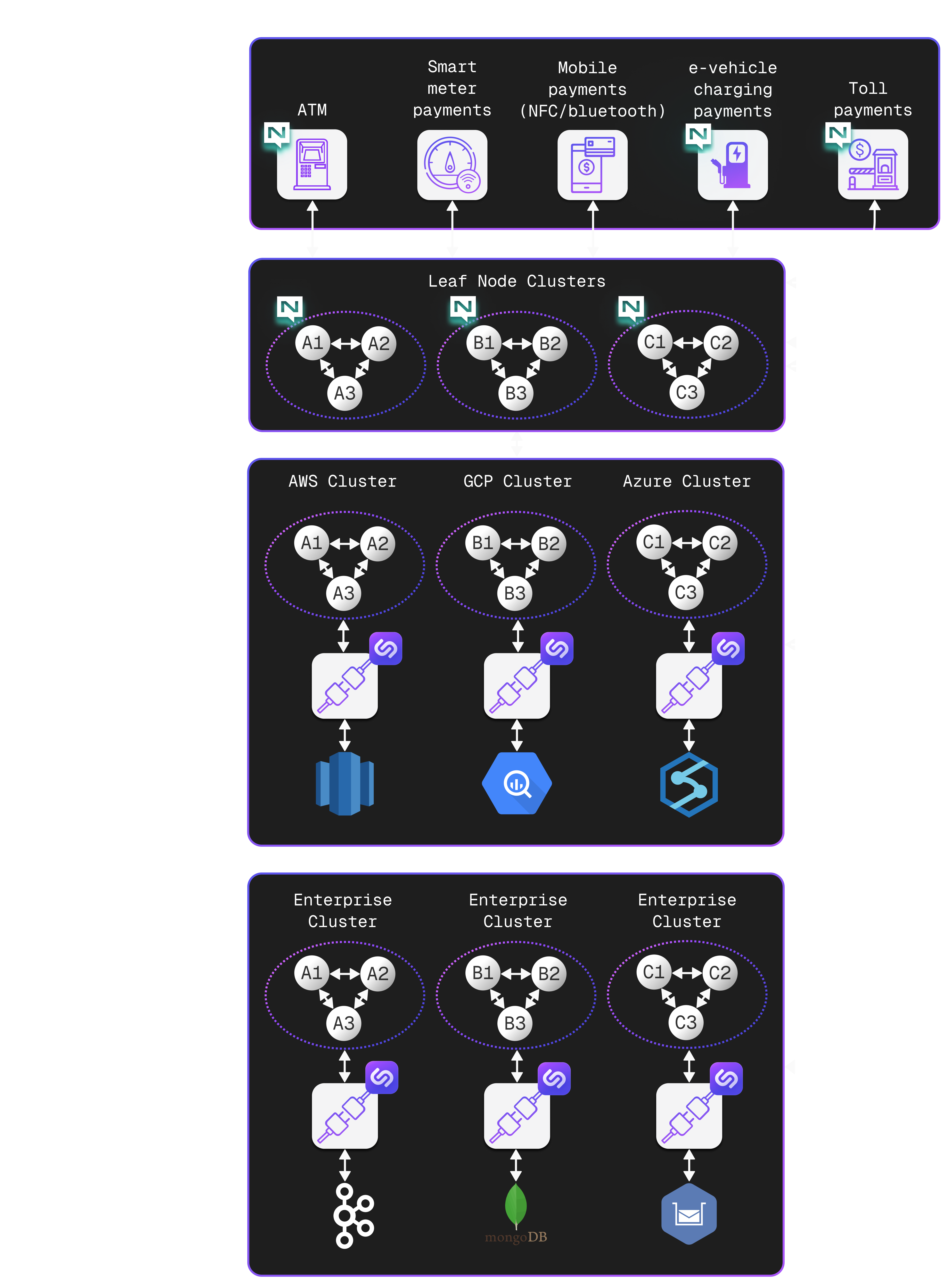
Designed for Engineers Who Build and Operate Critical Systems
NATS resonates with financial services teams because it reflects how modern systems are actually built and operated:
Event flows instead of brittle request chains
Horizontal scale without complex broker orchestration
Clear separation between producers, consumers, and state
Support for real-time, streaming, and request/reply workloads in one system
For data architects and platform engineers, this means fewer moving parts, clearer mental models, and architectures that scale with both load and organizational complexity.
Architectural Perspectives, Not Marketing Theory
The embedded slide deck walks through concrete architectural considerations and tradeoffs relevant to financial services environments—covering latency, topology, operational overhead, and system evolution.
These materials are intended as a reference for teams evaluating how event-driven messaging fits into modern financial platforms, whether you're modernizing existing systems or designing new ones.
Related Resources
Event-driven architecture is already reshaping how financial services platforms are built and operated—but the path looks different depending on whether you're focused on banking platforms, trading systems, or real-time payments.
The resources below explore how teams across financial services are using NATS to modernize infrastructure, reduce complexity, and support real-time workloads at scale. Each resource highlights a different perspective, from architectural patterns to real-world implementations.

NATS in the Banking Domain — ACI Worldwide
How event-driven architecture is reshaping modern banking platforms
Banks have historically relied on layered APIs and middleware to connect legacy systems. This resource examines why that approach increasingly limits scalability, resilience, and real-time responsiveness—and how event-driven architecture provides a more flexible foundation. It explores how NATS supports real-time data movement, system decoupling, and operational simplicity in modern banking environments.
Recommended for:
As banks modernize core systems, messaging infrastructure becomes a strategic choice. Event-driven models enable faster change, better resilience, and clearer system boundaries—without adding unnecessary operational overhead.

Building Event-Driven Banking-as-a-Service (BaaS) with NATS
Designing scalable, real-time banking platforms beyond API sprawl
Banking-as-a-Service platforms must support rapid product innovation, partner integrations, and real-time workflows. This resource explains why API-only architectures struggle under these demands and how event-driven design enables more adaptable BaaS platforms. It highlights how NATS provides a lightweight, high-performance messaging layer that supports growth without increasing architectural complexity.
Recommended for:
BaaS platforms need to evolve continuously. Event-driven systems allow teams to add capabilities, partners, and workflows without tightly coupling services or rebuilding core infrastructure.

Why FinecoBank Chose NATS for Next-Generation Trade Processing
Modern infrastructure for high-throughput, low-latency trading systems
Trading systems place extreme demands on performance, consistency, and reliability. This case study explores how FinecoBank modernized its stock trade processing layer using NATS and Synadia, focusing on predictable low latency, simpler system design, and the ability to scale under peak market conditions.
Recommended for:
In trading environments, infrastructure decisions directly affect execution quality and risk exposure. Messaging systems must deliver speed and determinism without introducing fragile operational dependencies.

How Form3 Built a Multi-Cloud, Low-Latency Payments Platform
Real-time payments infrastructure without cloud lock-in
Form3 operates a global payments platform that requires real-time processing, high availability, and multi-cloud flexibility. This resource details how Form3 used NATS and JetStream to build a resilient, low-latency payments system capable of operating consistently across cloud providers and regions.
Recommended for:
Payments systems demand both speed and reliability. Event-driven messaging enables real-time transaction flows while supporting geographic distribution, resilience, and regulatory requirements.
Ready for Event-Driven Infrastructure?
If you're responsible for designing or operating data-intensive systems in financial services, NATS is worth serious consideration—not as a niche messaging layer, but as core event infrastructure.
Explore how teams are using NATS to simplify architectures, reduce latency, and support real-time workflows across trading, risk, compliance, and analytics.