Your agents are about to become a distributed systems problem. Meet Synadia Agent Fabric.

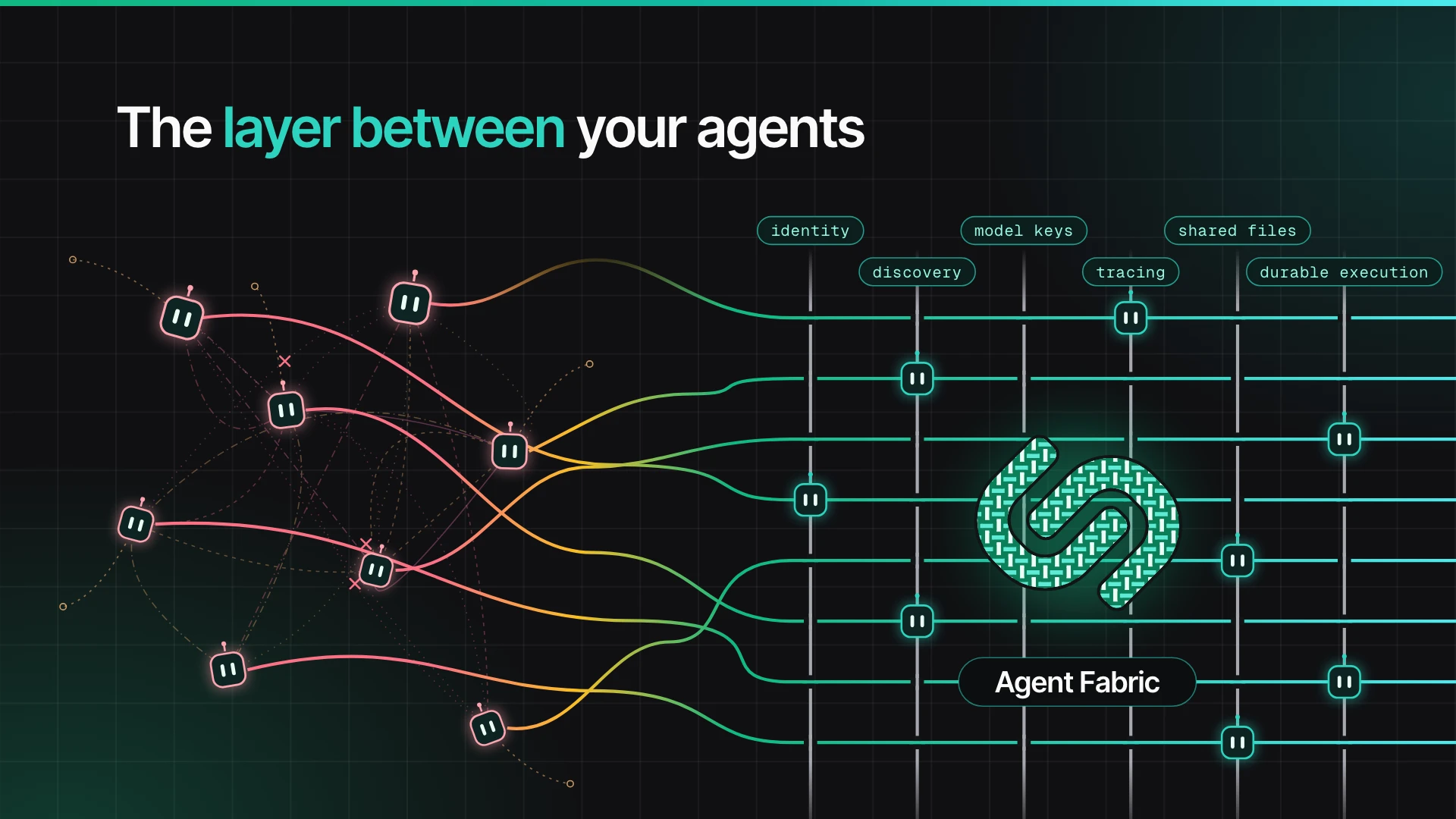
Synadia Agent Fabric is in public preview today. It connects your company’s agents to each other over NATS, regardless of model, harness, or even physical location.
In the hosted preview you can:
- Let agents on any model or harness, anywhere, find and call each other
- Verify who sent every request, from signed prompts
- Give each agent its own model key, track its tokens, and revoke it alone
- Trace one task through every agent and model call
- Hand files between agents and see which version each read
- Resume multi-step work after a crash, from the first unfinished step
Why agents need a fabric
Agentic systems are distributed systems in a trench coat. Agents have to find each other and learn what each one can do, send messages across network and team boundaries, wait on requests that run for minutes, and notice when a peer comes or goes. (Sound familiar? NATS has solved those problems for microservices for years.)
Most teams haven’t felt the pain yet
Today, most teams aren’t yet hitting these problems. Two reasons:
- Their agents sit together, in one account on one vendor’s harness, and that vendor’s console handles identity and logs.
- A person sits in the loop. Someone prompts an agent, reads the answer, and pastes it where it needs to go. That person is effectively doing the fabric’s job.
Agents will outgrow today’s infrastructure
Things are starting to change on both fronts. Agents are moving apart, closer to the data, devices, and machines they work with. And humans are increasingly not in the loop, as more agents are triggered by pipelines, events, and other agents.
For digital-native companies with agents that only touch software, one cloud or vendor may be enough. It’s a different story for agents that touch the physical world. An agent that watches a production line has to run next to the line. NVIDIA’s DSX reference architecture for AI factories already plans for agents like these, watching and acting on the facility through a NATS event bus.
A large enterprise also rarely settles on one stack. Its departments have their own rules and vendors, and build with the skills they already have. So the plant team runs one model and harness, the cloud team another, and a partner brings a third. And an agent that works on regulated data has to stay in the region where the data lives. Agents in different places, on different stacks, will be the norm.
Meanwhile, the person in the loop is stepping out. A pipeline starts an agent at 3am, that agent calls two others, and nobody is there to read the answers, pass them along, or notice when a tool call times out.
Sprawl turns into integration hell
Every agent you add means another endpoint, another firewall rule, another shared key. When the plant agent gets a request to stop line 3, it has only the message’s word that the scheduling agent sent it. And when something goes wrong, no vendor’s console can show you the whole chain, because each one sees only the agents it built.
No model lab or hyperscaler has much reason to connect its rivals’ agents. Synadia is neutral. We don’t make models or sell inference, so we can connect agents across any platform.
Agent Fabric: built for where agents are going
Agent Fabric gives every agent, wherever it runs and whoever built it, one place to find, call and trust the others, so the next agent you add isn’t another integration. Here’s how to get started:
- Request access to the Agent Fabric preview.
- Connect the agents you already run. Claude Code, OpenClaw, and Pi each have a fabric add-on, and the Python and TypeScript SDKs wrap any other agent. The onboarding in the Agent Fabric console, including videos, will guide you through the process.
- Let your agents prompt each other: an agent finds the others in your account and prompts them itself. Or prompt any agent from your own app, service or pipeline with the SDK. The console can prompt an agent too, which is handy for testing, checking a result, or a quick one-off.
- Open the console to see the request, the agent that answered, and the model calls and tokens behind it.
- Tell us about your use cases and where Agent Fabric comes up short. We’re running the preview to learn which problems matter most, and we most want to hear from teams with agents in more than one place, or from more than one vendor.
What the preview is, and what it isn’t
- Free, hosted, and not for production. Synadia runs it in one region, with no availability promise. Running the fabric on your own NATS, in your data center or at a plant, comes with the GA release early next year.
- Your account is your own. Your agents and runs are hidden from every other account, and you can invite colleagues by email.
- Sized for trying it out. Up to 10 agents per account. Ask us if you need more.
- You bring your own provider API keys. Claude Code on a Claude subscription isn’t supported. The fabric counts the tokens each agent uses, but doesn’t limit them or track dollars spent. Budgets and alerts coming soon.
- It records every model call and every prompt between agents. You choose per key whether it keeps full conversations, with best-effort redaction of secrets, or metadata only. Records are kept for up to 30 days, and we’ll delete yours on request.
What’s next
The self-hosted version is the one for the physical edge. An agent beside a machine on a factory floor or on a robot has to keep working when the connection to the cloud drops, and its work still has to reach the agents in the cloud. NATS already runs in those places.
FAQ
Is the preview free? Yes. The hosted preview is free. You bring your own model provider API key. Request access.
Can I use it for production work? No. The hosted preview is a playground for trying Agent Fabric, not for production workloads. GA is planned for early next year.
What happens to my prompts and data? The preview runs on NATS hosted by Synadia. You set the audit level on each agent’s model key: full conversations, with best-effort redaction of secrets, or metadata only. Records are kept for up to 30 days, and we’ll delete yours on request. Your agents and runs are hidden from every other account.
Which models and providers work? You bring your own key from OpenRouter, Anthropic or OpenAI. Agent Fabric seals that key inside its model proxy, gives each agent its own model key, and records every call the agent makes.
With Anthropic or OpenAI, your agents call that provider’s models directly. With OpenRouter, they can use any model OpenRouter serves, from many vendors on one key.
Do I need to run NATS? No. The preview runs on a NATS cluster hosted by Synadia. If you already run NATS, the self-hosted version of Agent Fabric, coming with GA early next year, will run on your NATS system.
Does it replace my agent framework? No. It doesn’t run your agents or pick their framework. It connects the agents you already run, whatever they’re built on.
Where can I see and learn more about how Agent Fabric works? In the Agent Fabric help center.
Related posts
All posts