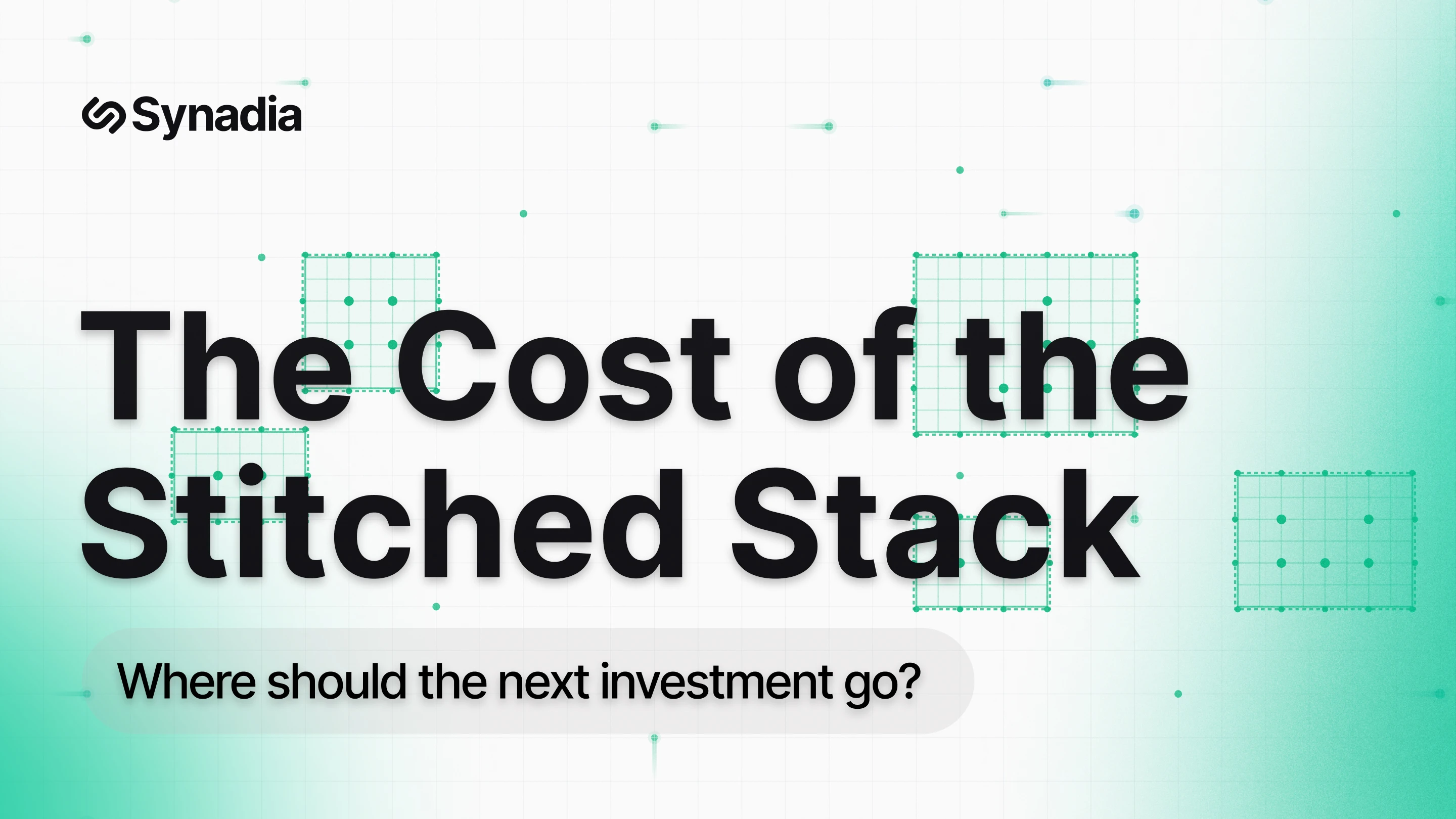
The cost of the stitched stack: why AI stalls before it reaches the edge

For the last fifteen years, “moving to the cloud” was the thing every CIO had on the roadmap. The investment thesis was simple: centralize, standardize, and ship faster. On margins, speed, and optionality, the cloud delivered.
Fifteen years on, that thesis is incomplete. The next decade of competitive advantage won’t be won inside a single cloud region. It will be won wherever your data, your decisions, and your customers live: in vehicles on the freeway, on factory floors, in retail stores during a Friday rush, on devices at the far edge of your network. Cloud-only architectures were never built for any of that.
The architecture problem hiding under “AI strategy”
Sit in a board meeting today and you’ll hear about AI, agents, and automation. The engineering review the next morning sounds much less glamorous: data pipelines, message queues, gateway translations, and integration brokers, stitched together by a small team of people who know where the seams are.
Most enterprise AI initiatives stall in the gap between those two rooms. The bottleneck is rarely the model; it’s the system wrapped around it.
A quieter convergence is happening in that same gap. The things we’ve been calling “AI agents,” “edge devices,” and “microservice endpoints” turn out to be the same thing wearing different uniforms. All of them share four requirements:
- Connect to other components, wherever those components live.
- Communicate in real time, securely, with delivery guarantees.
- Discover each other dynamically as workloads scale up and down.
- Secure every connection against an attack surface that no longer ends at the data center wall.
Treat agents, edge, and microservices as three separate engineering problems, each with its own team, and you end up with five vendors, three protocols, and an integration tax that compounds every quarter.
The cost of the stitched stack
Look at how most enterprises move data between cloud and edge today: a message broker here, a second broker for the IoT side, middleware handling cloud-region replication, gateways translating between protocols, and bespoke integration code holding the whole thing together.
Each piece works on its own. Taken together, the system is slow, expensive, and brittle, and three costs follow. New initiatives wait on data plumbing instead of getting to market. Multi-vendor licensing and the specialized teams needed to run it compound the run-rate. And every architectural change, whether that’s a new region, a new edge tier, or a new device class, re-opens the same plumbing problem.
This is why “we’re investing in AI” so often reads, in the financials, as “we’re investing in integration.”
Five outcomes the C-suite is actually buying
The fix is to collapse that complexity into a single connective layer. Done well, that one architectural decision converts into five business outcomes, the same ones VPs and C-suite leaders are already evaluating vendors against.
1. Cut infrastructure cost and complexity. One lightweight platform replaces the stitched-together stack of message queues, middleware products, and bespoke integration code. Fewer vendors, fewer specialized teams, faster change cycles, and the same operational model in cloud, on-prem, and at the edge.
2. De-risk every cloud bet. A cloud-agnostic backbone meets GRC requirements and removes single-vendor lock-in. Multi-cloud and hybrid become genuine optionality rather than expensive hedges, because the architecture adapts as the business does.
3. Secure beyond the perimeter. Once applications leave the data center, perimeter security stops working. Zero-trust has to be the default rather than a bolt-on: every connection authenticated, authorized, and encrypted, from cloud to far edge, with identity traveling alongside the workload.
4. Decide at the speed of action. Batch processing was an architecture, not a strategy. Vehicles, retail floors, factories, and energy infrastructure don’t wait for tomorrow’s report, and sub-millisecond data delivery at the point of action means you act in the moment instead of finding out on Monday.
5. Ship AI and edge initiatives faster. The AI stack is a data movement problem in a wig. Collect, process, and route data to AI agents in real time, whether the workload runs in a data center or on a low-powered device at the far edge, and models stop going stale waiting on the pipeline.
All five come from one platform, not five products.
What the architecture looks like
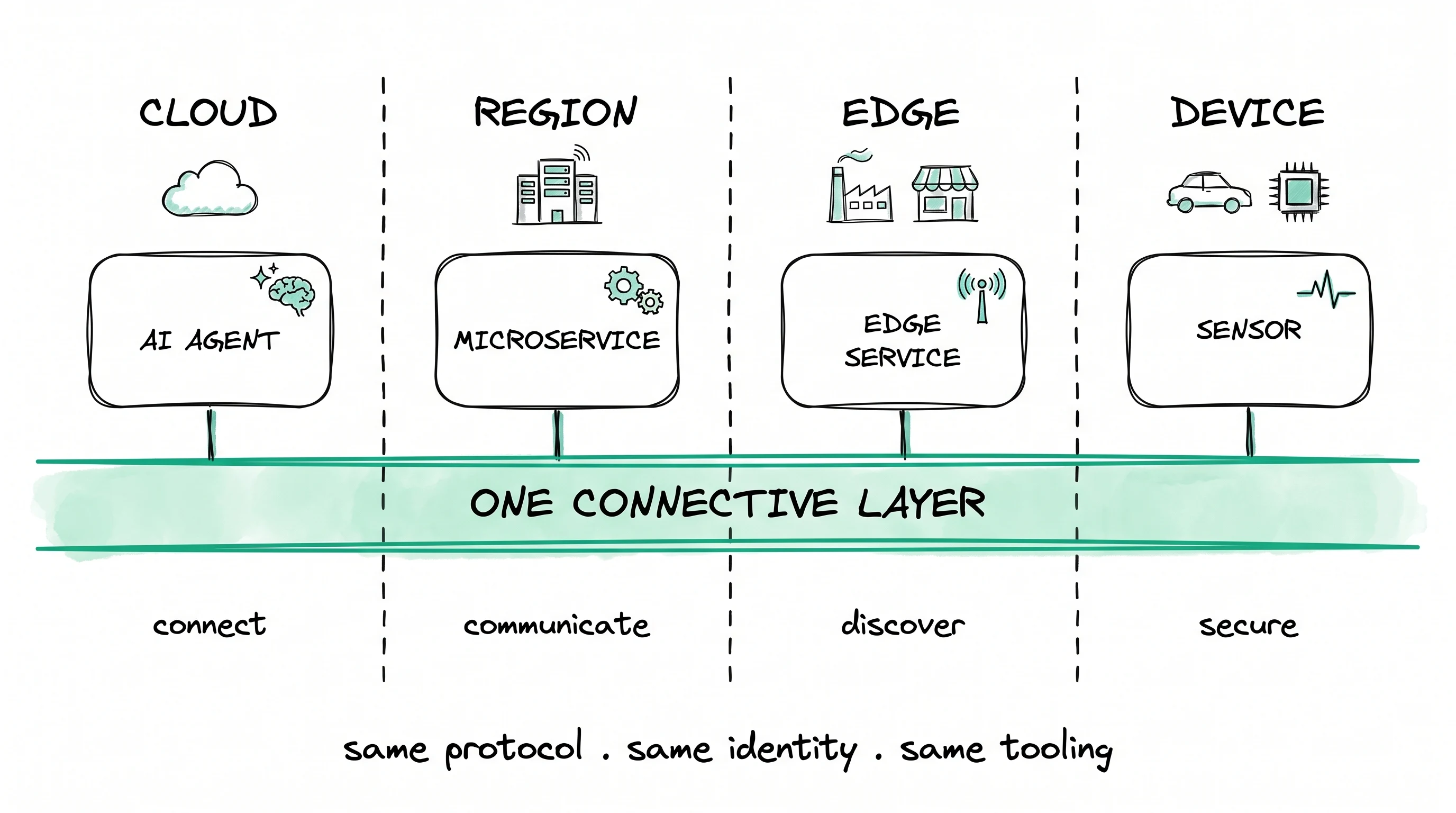
One unified data plane spanning cloud, regional, edge, and device tiers, with the same protocol, the same identity model, and the same operational tooling everywhere. Workloads move freely up and down the stack as latency, sovereignty, and cost dictate. A new region or a new edge tier doesn’t trigger a re-architecture; it’s an extension of the same fabric.
This is what we mean when we describe Synadia as the connective layer for intelligent, agentic applications. It’s the nervous system that lets every agent, device, and microservice (whatever you call them today, whatever you call them tomorrow) connect, communicate, discover, and secure on one fabric.
Who’s already running this way
NVIDIA, Mastercard, Rivian, Calix, and dozens of other enterprises rely on Synadia today to move data in real time, reduce infrastructure complexity, and get distributed and agentic products to market faster. Each arrived from a different place (semiconductors, payments, electric vehicles, broadband) and each hit the same ceiling, the one cloud-only design imposes once applications need to live everywhere.
Verrus is a recent example worth watching: a flexible data center company absorbing AI-era power demand with battery storage, running NATS as the unified namespace and data plane that carries real-time telemetry and secure two-way control between every facility and its cloud. Their principal software engineer walks through the whole architecture here.
The pattern repeats across industries because the underlying physics repeats. Data has gravity and decisions have deadlines, and the applications that win the next decade will be the ones whose architecture treats both as first-class.
What to do this quarter
If you’re a CIO, CTO, CISO, CFO, or CDO trying to decide where the next dollar of infrastructure investment should go, three questions are worth asking:
- How many separate systems are we paying for to move data between cloud, region, edge, and device today, and what would it cost to consolidate them?
- Where in our roadmap are AI or edge initiatives stalled on data plumbing rather than on the model or the use case?
- If we had to extend zero-trust to every device and partner connection by next year, do we have one architecture that covers it, or would we be bolting one on?
If the answers are uncomfortable, this pivot belongs in the next budget cycle, not the someday pile.
Want to see what one connective layer looks like in your environment?
Related posts
All posts